2025-26 School Year ISB Education Highlights
The 2025–26 school year has concluded, but ISB Education continues to build momentum through curriculum development, statewide educator engagement, conferences, and a busy summer of student research.
Spring 2026
The 2025–26 school year has wrapped up, and we’re now in the midst of a very busy summer. A few highlights from ISB Education are described below.
Expanding Access to Teacher Learning
Several of our most popular teacher workshops were transitioned to a self-learning format on the Canvas platform. This allowed us to reach teachers in more distant locations, better accommodate busy schedules, and engage participants more deeply in their professional learning.
SEE classroom resources were further tested, revised, and finalized. They’re being used with ISB’s summer high school students and are ready to be disseminated during the upcoming school year. The newest modules include Systems Medicine: Personalizing Disease Treatments, Rules of Life, and Arctic Microplastics: Mega-Problem?
ISB Education on the Road
The ISB Education team shared our resources and lessons learned at many conferences and events:
- October 20-21, 2025: Virtual NIH Science Education Conference & Center for Systems Biology Consortium (CSBC) Annual Conference
- October 25, 2025: Tacoma, Wash. — Washington Science Teachers Association (WSTA) Conference, “Microplastics in the Arctic: Mega-Problem?”
- October 31, 2025: St. Louis — National Association for Biology Teachers Conference, “Modeling and using a Lateral Flow Assay (LFA) to detect a human breast cancer biomarker”
- February 26, 2026: Virtual WSTA Workshop – “The Art of Asynchronous PL: An ISB Showcase on Deepening Science Instruction via Canvas”
- February 27, 2026: Glasgow, Scotland — AGU Ocean Sciences Annual Meeting: Translating Arctic Microplastics Research into a two-week Curriculum Module for Secondary Classrooms
- March 11, 2026: Virtual NIH NCI CSBC Steering Committee DREAM-High presentation
- April 15-18, 2026: Anaheim, Calif. — National Science Teaching Association Conference Presentations: “Microplastics in the Arctic: Mega Problem?” and “Taking Action for a Healthier World: Catalyzing a Systems Approach to Studying Scientific Wellness, Disease, and Health Careers.”
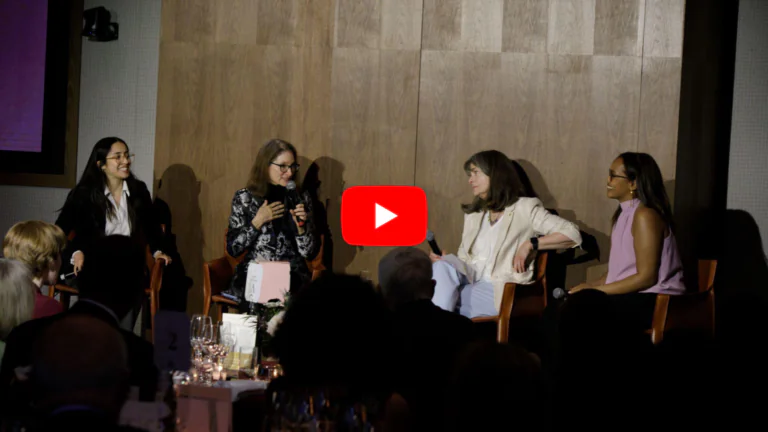
- April 15, 2026: Seattle’s Chapter of the Association for Women in Science presentation by Nobel Laureate Dr. Mary Brunkow, which included two ISB high school interns hosting an ISB information table
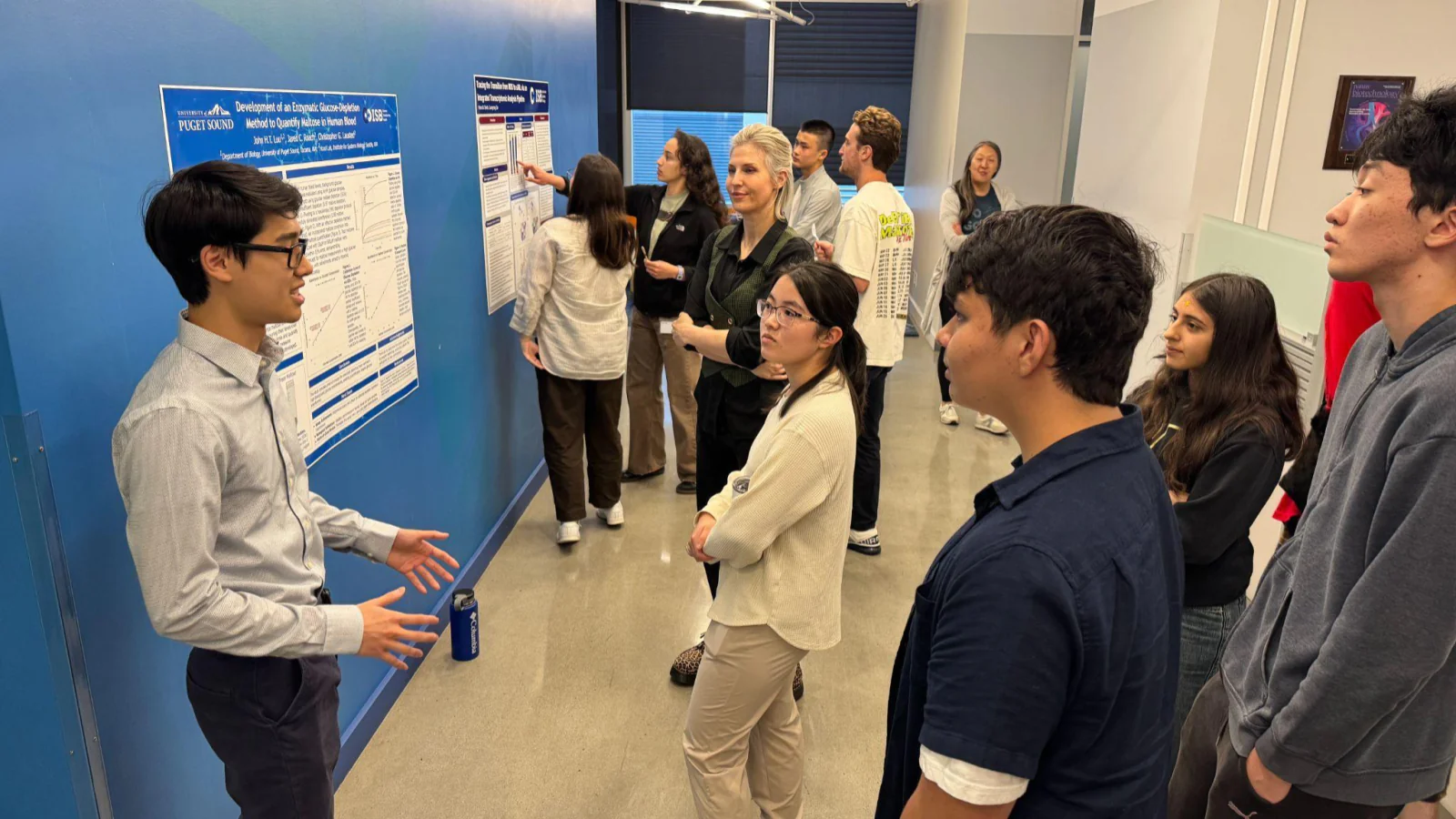
- April 16, 2026: Virtual REU PI conference, Presentation, “Early Poster Presentations Catalyze Student Learning”
- May 1-3 , 2026: Newport, Ore. — NWBIO Conference, Presentations, “Navigating the Tension: A Community Discussion on Rigor and Accessibility in Data-Intensive Biology” and “Hands On with the Next-Gen Bio Data Activities”
- June 10 , 2026: ISB’s An Evening of Laurels event celebrating Nobel laureate Dr. Mary Brunkow: event includes two students
We also contributed to the following recurring teaching support sessions:
- Quarterly — Puget Sound Biotech Advisory Committee
- Monthly — Science Leadership Lab
- Monthly — Friends of WA State LASER
- Monthly — Puget Sound LASER
- Monthly (September – June) — Online Systems Medicine Professional Learning Community series for eight teachers/schools involving 300 students
Summer Intern Season
Summer interns are in the midst of research at ISB.
This summer, the following labs are hosting students for summer research experiences at ISB:
- Baliga Lab — four high school and two undergraduate interns
- Gibbons Lab — one undergraduate intern
- Hadlock Lab — one undergraduate intern
- Hood Lab — two high school and one undergraduate interns
- Kuchina Lab — two undergraduate interns
- Thorsson-Shmulevich Lab — two high school and two undergraduate interns
- Venkatesh Lab — three high school interns
District STEM Leaders Gather at ISB
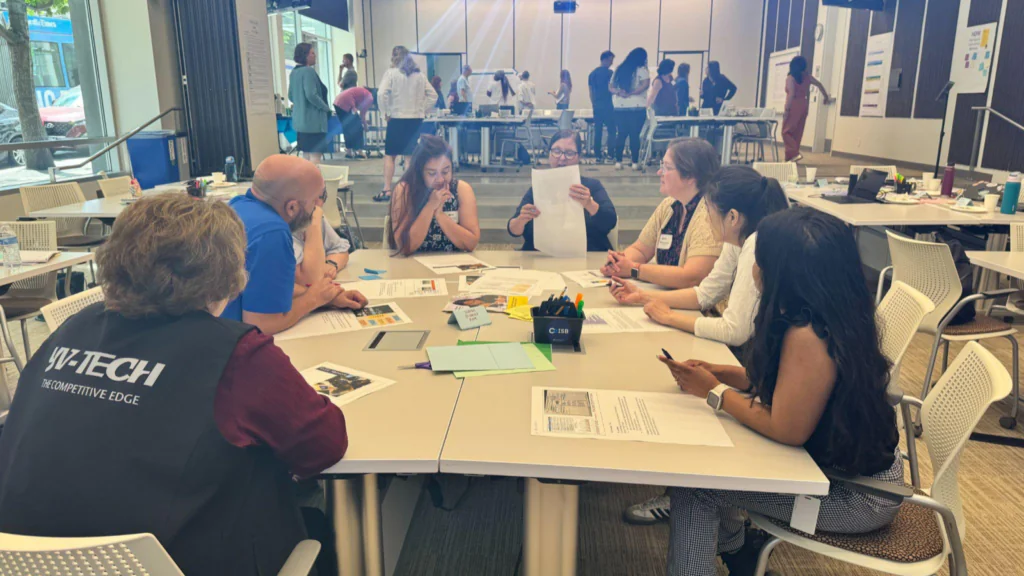
As soon as school was out many district leaders traveled to ISB for a full day of learning and collaborating in preparation for the upcoming school year.
The science/STEM leaders came to ISB from school systems across Washington state:
Battle Ground, Bethel, Cascade Christian School, Central Valley, Centralia, Chief Leschi, Clover Park, Edmonds, Everett, Franklin Pierce, Goldendale, Grand Coulee Dam, Highline, Kent, Lynden, Monroe, North Thurston, Okanogan, Puyallup, Renton, Seattle, Sultan, Sumner-Bonney Lake, Tacoma, Tukwila, Yakima
The workshop was supported by OSPI, for the ISB Education team to immerse the educators in an exemplary resource for selecting the science instructional materials (no longer textbooks!) for their schools’ K-12 science programs. The formula for the process the leaders explored is high quality instructional materials (HQIM) + high quality professional learning (HQPL) = transformational science learning experiences for every student at every grade level.
A highlight was the “Science Circle”, in which Jim Heath welcomed the leaders to ISB as a true STEM workplace. Jim launched the circle talk passionately, about CURIOSITY being the key STEM pathways for students. Other ISB researchers, interns and staff shared their ideas then educators joined the circle talk.
Winter 2025/2026
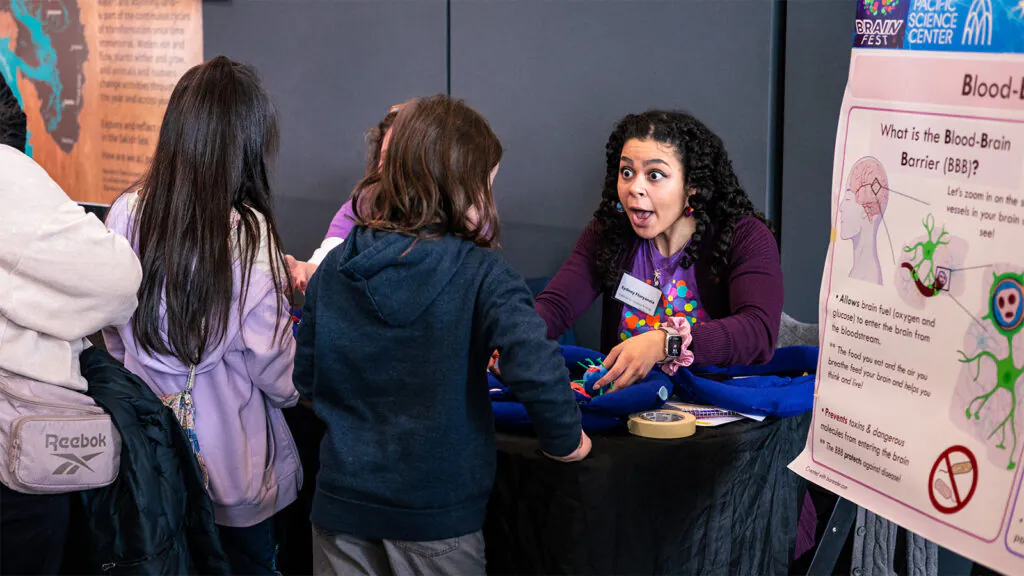
2,800+ People Learned About ISB Science and Careers Through 5 Community Events.
ISB Education joined four opportunity fairs to share ISB science and career opportunities with local communities through the Seattle Housing Authority, Burien Library, Rainier Scholars, and UW Young Executives in our Community (YEOC). Also, on March 21, we participated in BrainFest at the Pacific Science Center with Allen Institute and UW Neuroscience. The Blood Brain Barrier Breakout interactive activity was a big hit for the second year in a row.
50+ Students Came to ISB on Field Trips to Learn About What It Means to Be a Scientist.
They had opportunities to talk to scientists, see our spaces, and participate in hands-on learning. They help us all see ourselves through fresh eyes.
~1300 Students Applied to Participate in a Summer Research Experience at ISB.
Over 900 undergraduate and nearly 400 high school students completed applications. A few of these students will get the opportunity to do research in our spaces this summer. Hundreds more will get the opportunity to participate in virtual ISB Education programs that help them prepare for future STEM careers.
~2000 Students Told Their Teachers About How They Best Learn in Science Class.
In one of our school district partnerships, all 25 high school science teachers continue to survey their students each semester. Students are given prompts to reflect on what is helpful for their learning, and the responses are analyzed by the teachers to inform how they make improvements to their courses.
Fall 2025
We Appreciate Your Participation and Generosity at Ignite STEM
Ignite STEM lit up ISB on November 6! Our lobby was overflowing with students, educators, ISB faculty and staff, and supporters who gathered to celebrate 25 years of ISB’s education programs.
During the first hour, guests roamed among balloon-marked stations to hear stories from students, teachers, school district leaders, and STEM professionals — each sharing how ISB programs have shaped their learning and careers.
If you missed the event or want to relive the highlights, check out this slide deck of moments from the evening.
The sit-down program featured remarks from Mary Brunkow, who reflected on the educators and mentors who shaped her Nobel Prize-winning journey, and Angie Di Loreto, this year’s Valerie Logan Leadership in Science Education Award recipient, who shared her 25-year partnership with ISB and the Bellevue School District.
Jake Valenzuela led an engaging discussion on the importance of science education, invited guests to share their own ISB connections, and delivered the evening’s fundraising appeal. Jim Heath, Lee Hood, and Nitin Baliga offered remarks tying ISB’s research and education missions together.
The Education team — Claudia Ludwig, Jen Eklund, and Caroline Kiehle — extends their gratitude to everyone who contributed to a successful event, with special thanks to the Development, Facilities, Communications, and Faculty teams.
10 interns across five ISB labs are completing research
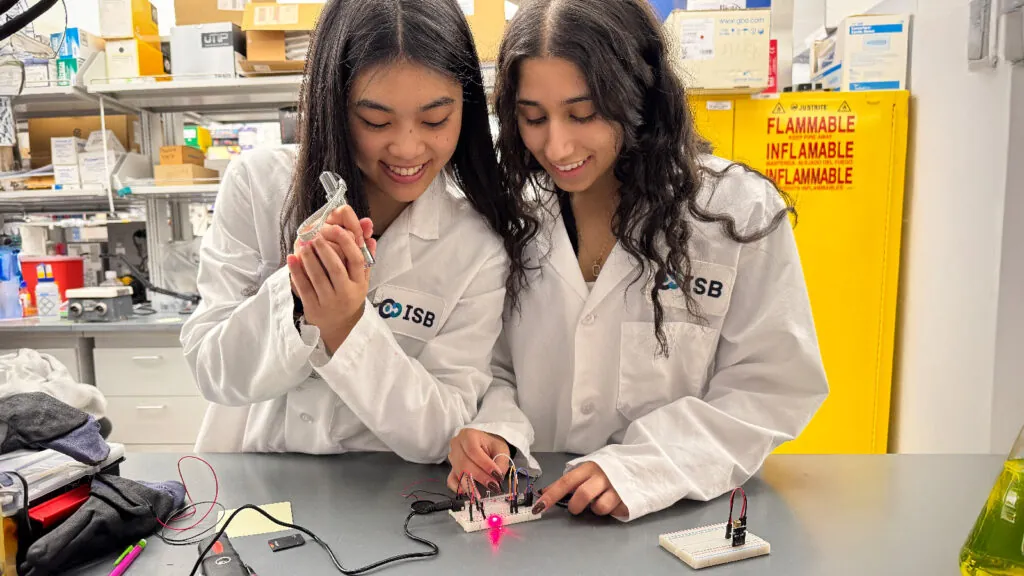
Eight local high school students and two undergraduates are researching in a variety of areas of systems biology in the Baliga, Huang, Kane, Moritz, and Venkatash labs. Above, interns Jessica Jin, left, and Sanjna Sikka are pictured working on a laser-activated speaker at ISB.
It is relatively unusual for ISB to host so many interns during the school year. However, this year, numerous students had release time for internships, and mentors had suitable projects and bandwidth. These students will wrap up their projects by June 2026 in time for our next cohort of students to arrive for new summer research experiences.
Systems Medicine Course Materials In Demand
Seven high schools, representing nearly 300 high school juniors and seniors, are currently using our Systems Medicine 4-module series. Since we began field testing these materials, we have reached over 1,000 students across 12 school districts.
In October, we presented instructional materials from our Personalizing Disease Treatments module at the National Association for Biology Teachers, thanks to our partner EmbiTec/MiniOne. This and previous dissemination efforts are resulting in teachers in other states using materials.
We are also supporting teachers through a monthly Professional Learning Community. ISB faculty member Sid Venkatash presented to the group of teachers on 12/3/2025 to provide examples of how nutritional and cystic fibrosis systems medicine research is progressing.
Our Newest Curriculum Module Is a Big Hit
This fall, teacher Wendy Whitmer of Lakeside High School in Nine Mile Falls, Wash., field tested our module, Microplastics in the Arctic: Mega Problem? with her two Biology classes. Below are a few standout quotes from 9th and 10th graders.
In October, we presented in Tacoma at the Washington State Teachers’ Association conference and got many other teachers up and going with this engaging, hands-on module. In total, we’re working with 16 teachers to field test the module in middle and high school classrooms this year. Feedback has been very positive and helpful as we optimize and finalize the lessons’ content.
Quotes in response to, “What did you like about this unit? What worked for you?”
- I liked that we got lots of days to work on a big project with a partner and that we got to use the lab.
- I liked all of it, and it all worked for me.
- What I liked about this experiment is that you could clearly see that the ice froze at different temperatures.
- It was pretty interesting to learn about all this stuff.
- I really loved learning about the causes and effects of the environments in the Arctic. It really encouraged me to do my part and have ideas about the Arctic Ocean. I also enjoyed the lab experiments.
- I liked the parts where we found potential solutions and in the lab things because it really showed what was going on.
- I liked learning about the impact we have on the world around us, and the labs worked very well to help me learn.
- I liked working on an actual project, instead of just working on a worksheet or a packet, and that worked for me, so that I’m not doing the same boring, less interactive thing over a few days.
- I have liked researching and learning all about the Arctic and microplastics, and what I can do to help.
Supporting Local School Systems to Launch the New Academic Year
ISB Education ran a workshop at the Puyallup School District‘s back-to-school institute. A group of secondary teachers from the science, math, social studies, and English departments worked together to explore student practices across the curriculum. The workshop gave teachers a practical experience in how to help their students see all the practices — the skills for doing science as a scientist would. Teachers then searched for overlaps in the other courses, generating a powerful set of practices that their students might be doing across their courses on any given day at high school.
ISB Education is running a yearlong series, year four, in the Central Kitsap School District. In October, all high school science teachers analyzed big data sets of students’ reflections on their learning — the n=2,000 students at each of four timepoints over two years. This is a powerful view of science teaching and learning, from which the teachers established professional growth goals for our collaborative work this year.