Media Coverage
Filter
-
- All Categories
- Brain Health
- Cancers
- Cell Dynamics
- Computational Biology
- COVID-19
- Disease
- Environment
- Experimental
- Healthspan
- Healthy Aging
- Immune System
- Infectious Disease
- Microbiome
- Nobel Prize
- Pregnancy Health
- Proteomics
- Scientific Wellness
Sort
-
- Default
- A-Z
- Z-A
- Newest
- Oldest
How Does Life Unfold? A Landscape Metaphor Comes Into Its Own.
ISB’s Sui Huang is featured in an exploration of how scientists are turning a decades-old metaphor of cellular development into a measurable biological framework. His pioneering research has helped explain how cells acquire distinct identities, with implications for understanding cancer and potentially guiding cells toward healthier states.
Twenty Nobel Prize Winners Who Transformed Modern Biochemistry
ISB’s Mary E. Brunkow leads a roundup of 20 Nobel Prize winners whose discoveries have transformed modern biochemistry. The feature highlights her pioneering co-discovery of the FOXP3 gene, which revealed a critical mechanism for preventing autoimmune disease and opened new possibilities for treating immune disorders and cancer.
Molecular Pathways Driving Autoantibody Production Following SARS-CoV-2 Infection Identified
ISB researchers Jim Heath and Dan Yuan are featured in coverage of new findings revealing how SARS-CoV-2 infection can trigger harmful autoimmune responses. Their research identifies specific immune cells and molecular pathways responsible for producing autoantibodies, offering new insights into Long COVID and potential targets for future therapies.
Forbes 50 Over 50
Forbes named ISB Distinguished Investigator and 2025 Nobel laureate Mary Brunkow to its 2026 “50 Over 50” Innovation list, which recognizes women making significant contributions later in their careers. Brunkow was recognized for her groundbreaking research into regulatory T cells and discoveries with important implications for autoimmune disease and drug development.
Having Long COVID Worsens Heart-Related Fitness, Study Finds
ISB’s Jim Heath and Jennifer Hadlock contributed to a multi-authored paper that was highlighted for finding that people with a higher burden of long COVID symptoms tend to be less physically active and exhibit poorer measures of cardiovascular fitness.
DNA Databases Unite to Create a Fully Open Resource for Transposable Element Research
A new collaboration between the Dfam and Repbase databases creates the first fully open resource for transposable element research. This story explores how the unified platform will accelerate genome annotation, evolutionary biology, and biomedical research by making decades of expertly curated data freely available to scientists worldwide.
Mary Brunkow Discusses the Resilience and Future of American Science
Scientific American spoke with ISB Distinguished Investigator and 2025 Nobel laureate Mary Brunkow about the challenges facing American science, the resilience of scientists, and reasons for optimism. Brunkow also discusses the importance of communicating science, advances in systems medicine, and her advice for researchers early in their careers.
As Graduates Push Back on AI, UW’s Nobel-Winning Commencement Speaker Takes Different Approach
This feature of Mary Brunkow ahead of the University of Washington commencement highlights her thoughtful perspective on artificial intelligence, scientific curiosity, and the enduring importance of human judgment in research. The story contrasts Brunkow’s measured approach with the broader national debate over AI at college graduations.
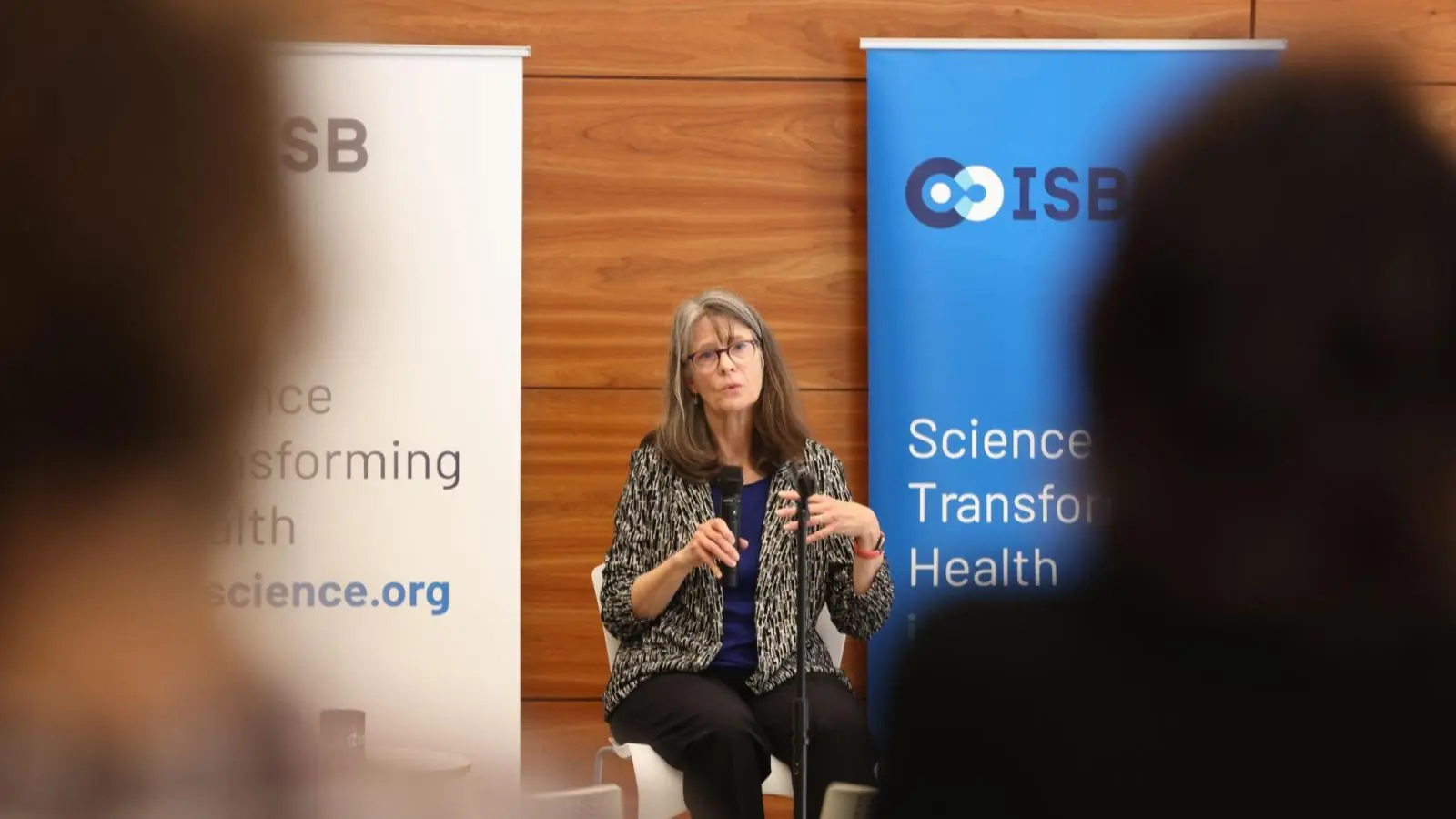
Nobel Laureate Dr. Mary Brunkow speaks at a press conference held at ISB on October 7, 2025. (Photo by Alex Garland for ISB)
ISB’s 2025 Nobel Prize Coverage
ISB’s Dr. Mary Brunkow received the 2025 Nobel Prize in Physiology or Medicine for transformative discoveries in immune tolerance.
Visit our Nobel Prize hub page for stories, photos, reactions celebrating this historic achievement, and more.