Media Coverage
Filter
-
- All Categories
- Brain Health
- Cancers
- Cell Dynamics
- Computational Biology
- COVID-19
- Disease
- Environment
- Experimental
- Healthspan
- Healthy Aging
- Immune System
- Infectious Disease
- Microbiome
- Nobel Prize
- Pregnancy Health
- Proteomics
- Scientific Wellness
Sort
-
- Default
- A-Z
- Z-A
- Newest
- Oldest
AI for impact: AWS awards Imagine Grants to pioneering nonprofits across three continents
The Institute for Systems Biology (ISB) has been awarded a 2025 AWS Imagine Grant — funding that will accelerate the development of its generative-AI platform Tarpon, which creates “digital fingerprints” of T-cell receptors, enabling faster discovery and design of targeted immunotherapies.
Molecular biologist Mary Brunkow is the Nobel Prize winner next door
This feature traces the remarkable arc of Mary Brunkow — from undergraduate at the University of Washington to 2025 Nobel Laureate — spotlighting her foundational discovery of the gene FOXP3, and how that breakthrough unlocked a new understanding of immune-system self-tolerance. The story also reflects on the years of basic research, the long-standing impact on immunology, and how Brunkow’s journey connects back to her roots in Seattle’s scientific community.
Your Poop Schedule Says a Lot About Your Overall Health, Study Shows
ISB-led research from the Gibbons Lab shows that how often people have bowel movements is linked to overall health and disease risk. The study suggests an optimal “Goldilocks” range of once or twice daily, with deviations associated with broader physiological changes.
Dr. Sean Gibbons: Toilet Visits, How Often And How Long
ISB’s Dr. Sean Gibbons explores the science of bowel habits and the microbiome, explaining how frequency, timing, and stool form reflect overall health. The conversation connects everyday experiences with cutting-edge research on digestion, diet, and the trillions of microbes that shape human well-being.
Dr. Lee Hood on Systems Biology, P4 Medicine, and the Future of Health
Dr. Lee Hood joined podcast host Jeremy Koenig to discuss the evolution of medicine from reactive care to P4 health. He explored eight paradigm shifts that have transformed biology and highlighted how systems thinking, big data, and AI are reshaping wellness and personalized care.
A conversation with UW alum and Nobel Prize winner Mary Brunkow
University of Washington alum Mary Brunkow has been awarded the 2025 Nobel Prize in Physiology or Medicine for pioneering research into how the immune system is prevented from attacking the body’s own tissues – work that has profound implications for autoimmune disease, cancer therapies, and transplant medicine.
Influenza A-infected volunteers display different patterns of expelling viruses into environment
Kathie Walters, lead author on the study, and collaborators found that individuals infected with influenza A display distinct viral-shedding patterns tied to immune history. Their work, published in Science Translational Medicine and covered by Medical Xpress, offers new insights on vaccine design and immunity.
Here are this year’s Nobel Prize award laureates and how they shifted the world’s perception of immune response
Explained PH includes ISB’s Dr. Mary Brunkow among the 2025 Nobel laureates whose discoveries revolutionized our understanding of the immune system. (Note – minor editorial inconsistencies included in original text.)
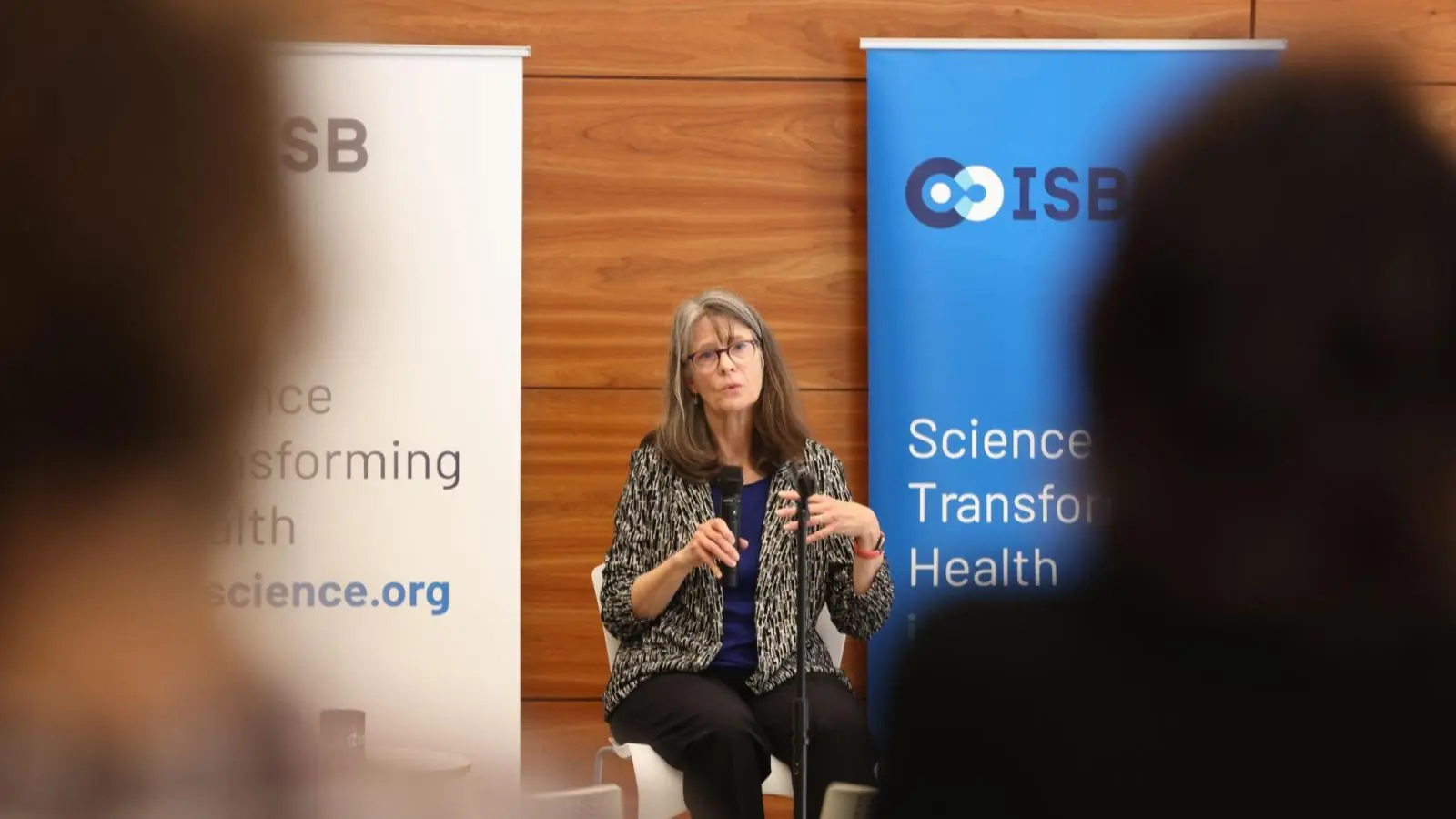
Nobel Laureate Dr. Mary Brunkow speaks at a press conference held at ISB on October 7, 2025. (Photo by Alex Garland for ISB)
ISB’s 2025 Nobel Prize Coverage
ISB’s Dr. Mary Brunkow received the 2025 Nobel Prize in Physiology or Medicine for transformative discoveries in immune tolerance.
Visit our Nobel Prize hub page for stories, photos, reactions celebrating this historic achievement, and more.