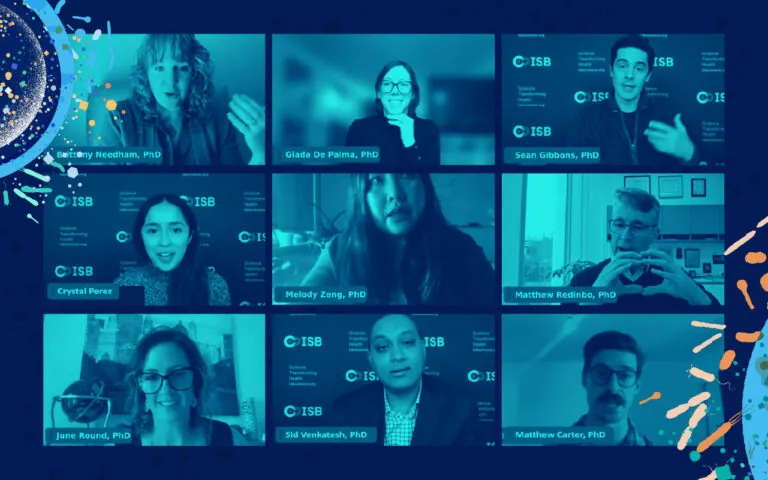
Microbial Metabolites and Human Health Take Center Stage at ISB’s 2025 Virtual Microbiome Symposium
Six leading experts from across the field presented new insights to more than 1,000 registrants worldwide, with over 400 participants joining live.
ISB hosts both in person and virtual courses and symposia throughout the year on a variety of topics. Intended audiences include PIs, postdocs, graduate students, industry scientists, educators, and anyone else interested. We announce these events on our website, through our mailing list and on our social channels.
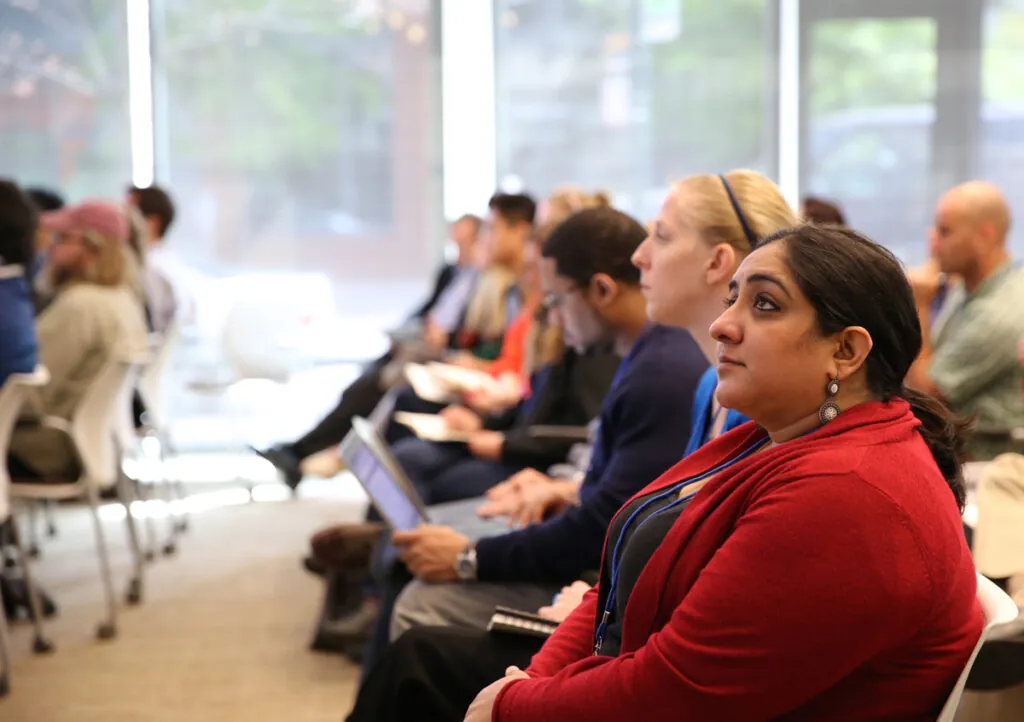
Audience members at a scientific event held at ISB headquarters in South Lake Union, Seattle. Image credit: ISB.
There are currently no upcoming courses or symposia. Recordings of previous courses are available to view below.
Six leading experts from across the field presented new insights to more than 1,000 registrants worldwide, with over 400 participants joining live.

There has been an explosion of research into the two-way communication between the gut microbiota and the brain. This year, ISB hosted a virtual microbiome series dedicated to exploring the gut-brain axis.

ISB hosted a full-day symposium – titled Resonance – celebrating the life and scientific contributions of Professor Ilya Shmulevich, who passed away in April 2024 from complications of acute myeloid leukemia.
The Cascadia Proteomics Symposium is a two-day event that happens annually every summer. It is held at the Institute for Systems Biology in Seattle. We encourage extensive participation of students and postdoctoral fellows. This is a great opportunity for people interested in proteomics to get to know each other better, share ideas, and foster collaboration within the region. Attendees can also submit abstracts and posters to participate in the symposium’s poster session.
The Seattle Proteome Center (SPC) at ISB offers intensive courses in the use of our suite of open-source software tools designed for the analysis, validation, storage and interpretation of data obtained from large-scale quantitative proteomics experiments and methods, multi-dimensional chromatography and tandem mass spectrometry. Through daily lectures and tutorials, each course participant should become proficient in the use of these tools, which comprise the Trans-Proteomic Pipeline (TPP).